Estonia just accused Russia of ordering a NATO defence firm arson attack
2 days ago · 29 September 2026Share
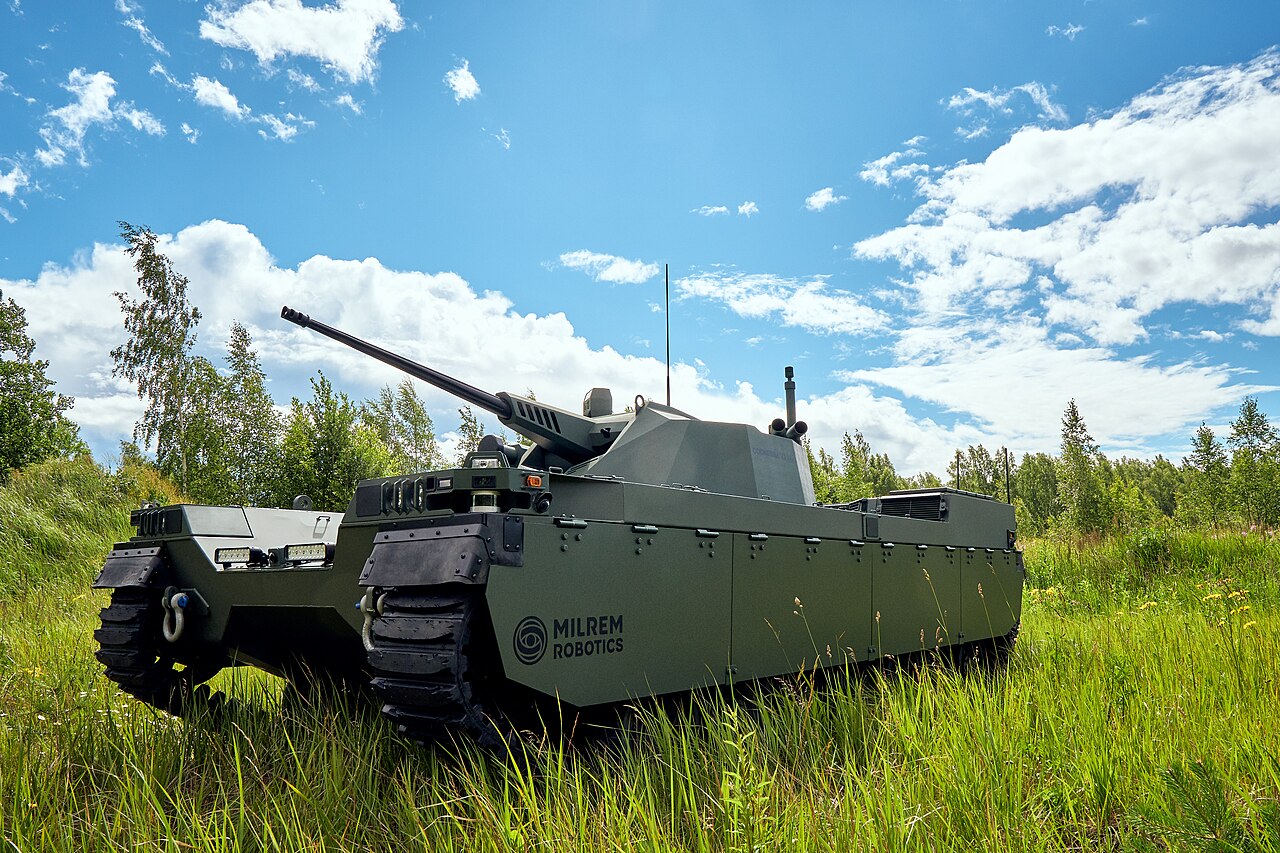
The Type-X Robotic Combat Vehicle manufactured by Milrem Robotics. File photo. Milremrobotics · CC BY-SA 4.0
Estonia says Russia ordered an arson attack on an Estonian defence company.
And three suspects are now sitting in Estonian custody.
The company is Milrem Robotics. It builds robot vehicles for Ukraine.
Margus Tsahkna, Estonia's Foreign Minister, says Estonia can state this with full confidence.
Estonia's Internal Security Service ran the investigation.
So what actually happened? Go back six weeks.
Overnight on 14 to 15 August, a fire broke out in a building on Betooni Street, in Tallinn's Lasnamäe district. Milrem Robotics used that building.
Emergency services put it out fast. Nobody was hurt.
Now here's why this building matters. Milrem builds THeMIS unmanned ground vehicles. Working with other EU countries, it sends them to Ukraine.
So hit this building, and you hit part of Ukraine's supply chain.
Two Latvian citizens were detained in Latvia on 17 August. A third was detained the next day.
Searches of places linked to them turned up data storage devices and materials that may have started the fire.
On 17 and 18 September, Latvia handed all three suspects over to Estonia.
Estonia says the people believed to have carried out the attack are now in custody. It says they no longer pose a threat.
The wider investigation into how the attack was planned is still going on.
And today, Estonia went further. It summoned the Russian chargé d'affaires in Tallinn.
That's a formal diplomatic protest. One government putting another on notice.
Margus Tsahkna says quote "an act of sabotage ordered by the special services of the Russian Federation".
And he says this isn't a one-off. He says it's part of Russia's broader campaign across Europe to intimidate Estonia and weaken support for Ukraine.
Kristen Michal, Estonia's Prime Minister, agrees. He says the sabotage fits that same campaign to intimidate Europe and cut support for Ukraine.
He says it actually shows Moscow growing more desperate, because Russia keeps failing to reach its goals in Ukraine.
The rest of this story is for members.
Contains modified Capella Space synthetic aperture radar imagery of Tallinn, Harju County, Estonia. Capella Space · CC BY 4.0
He compared Vladimir Putin to a rat in a corner, lashing out across Europe to break Western support for Kyiv.
But he still thinks a conventional Russian military attack on Europe is unlikely.
Margo Palloson runs Estonia's Internal Security Service. He says Russian special services keep trying to recruit and influence people across Europe to carry out sabotage.
He says organisations backing Ukraine, and defence companies like Milrem, now face a heightened threat.
Here's what Estonia isn't showing anyone. The intelligence behind all this stays secret. Estonia says confidentiality rules stop it going public.
But it says the attack matches other sabotage Russia has run elsewhere in Europe.
So what does Estonia do now? Tsahkna says Estonia will push for tighter sanctions on Russia. And tighter limits on Russian citizens travelling to Europe. And more support for Ukraine.
Russia's answer so far is a denial with no detail.
Dmitry Peskov, the Kremlin's press secretary, called the accusation baseless. He says such statements have no relation to reality, and that Russia will not take them seriously.
The Russian embassy in Tallinn has not answered requests for comment. Russia has said nothing specific about the ambassador summons.
And Estonia's allies have lined up behind it.
Mark Rutte, NATO's Secretary General, says Russia continues its reckless campaign of hostile actions against NATO allies — but is failing to break allied unity or support for Ukraine. He's urged countries to stay calm.
Ulf Kristersson, Sweden's Prime Minister, called the attack serious. He says Sweden stands fully behind Estonia.
Johan Wadephul, Germany's Foreign Minister, condemned what he called an act of hostility by Russia. He says Estonia has full solidarity from Berlin.
But not everyone agrees on how dangerous this is.
Mindaugas Sinkevičius, Lithuania's Prime Minister, says intelligence services have no proof Russia is about to prepare something bigger. He says the threat level isn't rising or falling. It's just staying where it is.
So how common is this? The Associated Press has tracked around 200 incidents of sabotage and other malign activity blamed on Russia across Europe since the full-scale invasion of Ukraine began in February 2022.
And this case follows something else. Days before today's announcement, Germany blamed Moscow for an explosive-laden drone found at an airport.
Estonia hasn't shown how it linked the attack to Russian intelligence. Russia hasn't given any detailed response to the accusation, or to the summons.
So what happens next is diplomatic, not military. Sanctions. Travel restrictions. And whatever Moscow decides to say back.
Nothing here was paid for by an advertiser. Members are the entire business model. Bronze is where it starts, and it opens the last seven days in full.