More than 25 tankers have been hit in the past week. Iran's navy says two of them hit mines and caught fire two days ago, after sailing into a restricted zone with their navigation switched off. No maritime authority has confirmed that.
That's everything we know.
Why this mattersSo how bad is the shipping collapse, really?
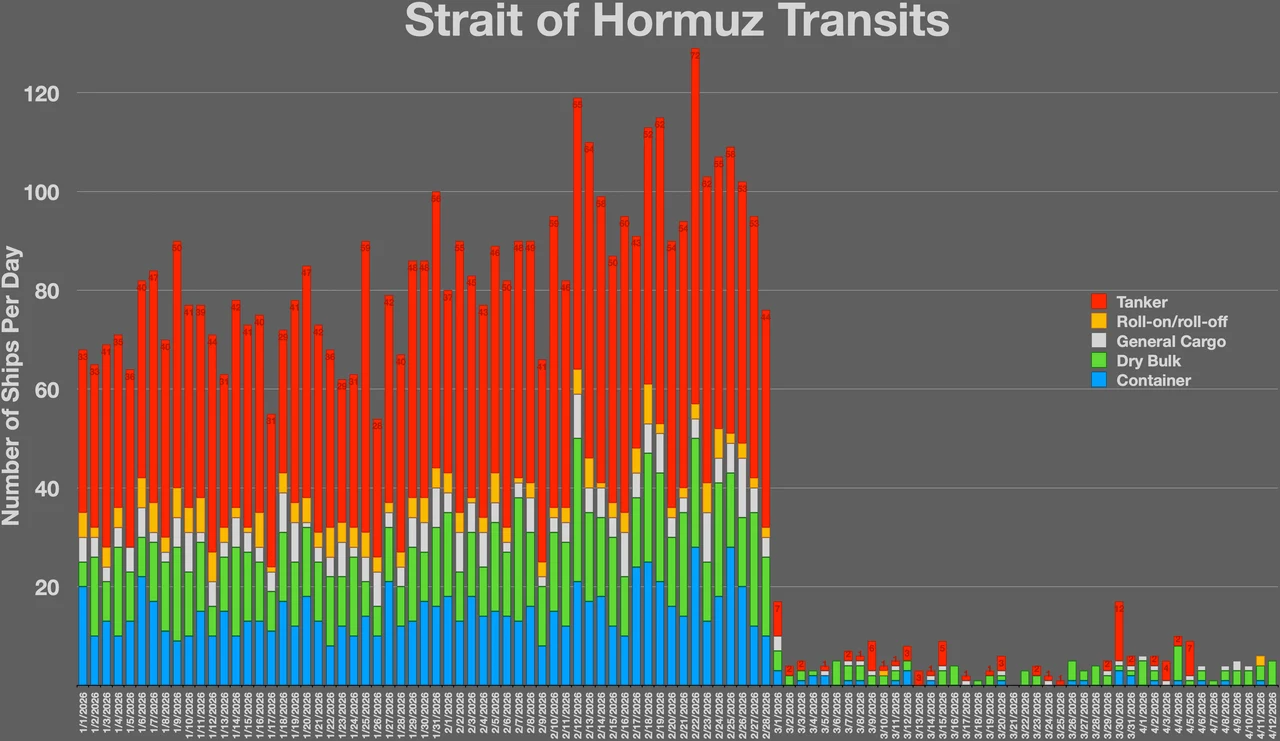
Al Jazeera looked at Marine Traffic data. In the first week of November, 226 ships crossed the Gulf. In the week of 17 to 23 November, just 125 did. That's a drop of more than 40 per cent.
Another tracker, UKMTO, says it's even worse. It puts total traffic at around 65 per cent below pre-war levels for the week to 18 November. Different method, different number. But both agree on one thing. Traffic has collapsed.
And here's the part that's genuinely unclear. The National reports that Iran's Supreme National Security Council held an emergency meeting around five days ago and decided to hold back a convoy of 14 oil tankers that was meant to challenge the blockade.
That claim comes from a single unnamed source. It hasn't been independently confirmed.
Iran's own state broadcaster, Irib, has denied any convoy set sail at all. It adds that Iran has other, unspecified ways to break the blockade.
So is Iran about to force ships through, or not? Even Iran's own channels don't agree.
Mohammad Bagher Ghalibaf, Iran's parliament speaker, has said there are military ways to break the blockade, and that Iran will pursue them soon. That line is only in one source so far.
Abbas Araghchi, Iran's Foreign Minister, told Ilna news agency that the blockade must be broken. He says Iran will keep exporting oil while pursuing negotiations at the same time.
Now here's how we got here. The US first imposed this naval blockade on Iran in April. It lifted it after a deal in June. Then that deal collapsed, and the blockade came straight back. Both blockades trace back to the war between the US, Israel and Iran that began in February.
A few days ago, US Central Command said ships taking on cargo transferred from Iranian vessels could now be treated as evading the blockade too. That shuts down a workaround Iran had reportedly been using to keep oil moving.
Scott Bessent, the US Treasury Secretary, says Iran's economy is under water and its leaders are panicking. The Treasury has announced new sanctions on Iran's financial networks on top of that.
And Iran's economy backs that up. Inflation hit 88.7 per cent in October. About 1,200 lorries are stuck in a 42-kilometre queue at the Kazakhstan-Uzbekistan border. Iran has brought in electricity cuts. Iran's President, Masoud Pezeshkian, was seen this weekend in a dimly lit office wearing a winter coat, in line with his own call to save power.
So both sides say they're winning. Iran says the blockade itself is illegal aggression, and that it has the right to use force to break it. The US, through CENTCOM, says the blockade is working. CENTCOM is said to claim it has denied Iran more than $30 billion in oil exports since July, with nearly 150 vessels diverted and five disabled. That figure could not be verified from the source given, and no other report reproduces it. So it is reported here only as an unconfirmed claim.
Oil briefly passed $120 a barrel after the latest mine incident, before falling back to around $88 to $89.
The head of Iran's naval forces within the Revolutionary Guard, Ali Ozmaei, has warned ships against using unauthorised routes through the strait. It isn't clear if that's a new threat or just Iran repeating an old one.
So what don't we know? Whether Iran will actually try to force a convoy through. When that might happen. And whether the US would answer that with direct strikes on Iranian ships, instead of the blockade it already has running.