Colombia just admitted it can't count its own drone war
1 hour ago · 6 October 2026Share
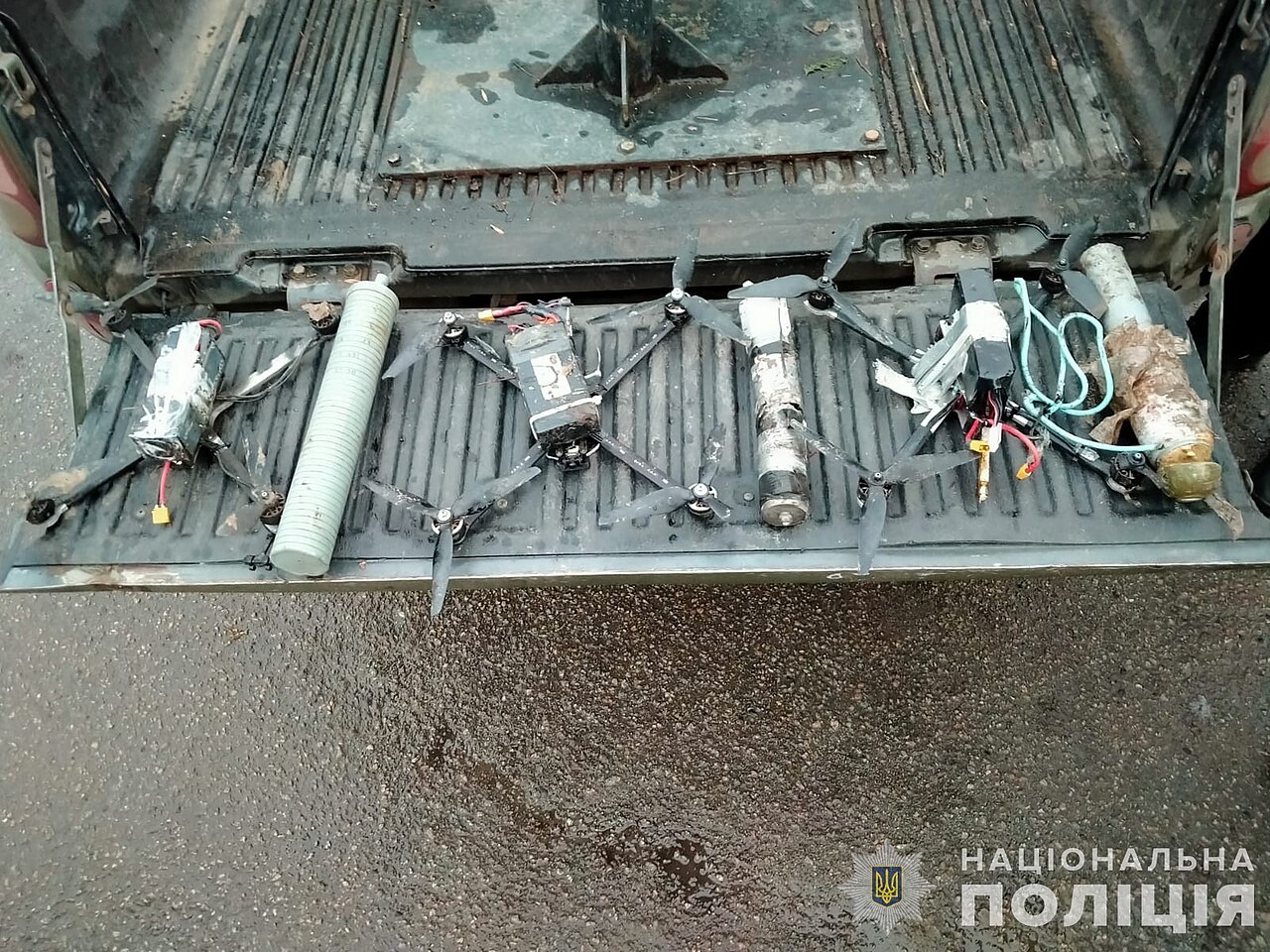
Drones with explosives sent by Russian troops landed by Ukrainian military in Dnipropetrovsk Oblast. File photo. National Police of Ukraine · CC BY 4.0
Colombia's armed groups have turned commercial drones into a routine weapon.
And Colombia's own government can't agree on how often it's actually happening.
Here's the headline number. A new intelligence consolidation, reported by the public broadcaster Telecafé a day ago, counts 442 drone attacks using explosives between 1 January 2024 and 1 October 2026.
The yearly trend is getting worse. 108 attacks in 2024. 158 in 2025. 176 so far in 2026, and there's still three months left to count.
That same report counts 25 people killed and 356 wounded.
So where is this happening most? Cauca department, in the south-west. 244 of the 442 attacks happened there. That's well over half.
But here's the problem. This isn't the only official count. And the others don't match it.
A separate tally from Colombia's Fuerza Pública, reported by Infobae through the newspaper El Tiempo nine days ago, counts 292 drone attacks by armed groups in 2026 alone, through 15 September. That's already close to the intelligence report's full-year figure, and September hadn't even finished.
The same Fuerza Pública count logs 418 drone attacks against the military specifically between 2024 and 2026, part of 688 total attacks of all kinds in that period. It puts the dead at 31 and the wounded at 456. That's 342 soldiers wounded and 22 killed, 59 police wounded and three killed, 55 civilians wounded and six killed.
Groups outside government cited by El Tiempo say the civilian death toll is actually 12, not six.
Then there's a third count. Colombia's Ombudsman's Office, reported by Al Jazeera three weeks ago, says drone attacks by armed groups rose 146% in the first five months of 2026 compared with the same period the year before. 21 people killed. 145 wounded, including children.
And a fourth. Colombia's Defence Ministry figures, cited via the analysis group ACLED, show 61 drone attacks in 2024 and 333 in 2025. But ACLED's own independent monitoring counted only 38 in 2024 and 149 in 2025.
Four official or institutional counts. Four different numbers. For periods that overlap. None of them reconcile.
What is consistent is the direction. More attacks every year, not fewer.
The tactic isn't new, even if the scale is. The Fuerza Pública count traces the first documented drone attack in Colombia to 21 July 2023, in Puerto Guzmán, Putumayo, attributed to a group called Comandos de Frontera.
The rest of this story is for members.
Bogotá cityscape.Lorna Phillips · CC BY 2.0
The first death from a drone attack came a year later. Dylan Camilo Erazo Yela was 10 years old. He was killed in El Plateado, Cauca, in July 2024, when a FARC dissident group's drone dropped an improvised device.
So who is doing this now? The Fuerza Pública's 2026 figures name names. Structures linked to the dissident commander Iván Mordisco are tied to 145 of the 292 attacks recorded this year. The ELN to 119. A faction linked to alias Calarcá to 26.
The Telecafé intelligence report says these groups have converted commercial drones into tools for surveillance, reconnaissance and low-altitude attacks, modifying them with off-the-shelf motors, cameras and batteries.
It adds that a significant part of this technology could originate in China, the world's largest consumer-drone manufacturer. But it says there is no public evidence that the Chinese government or Chinese companies promote its criminal use.
And the attacks keep coming. On 5 September, at least 20 explosive-laden drones hit a military compound in Ocaña, Norte de Santander, killing at least three soldiers. Colombia's Defence Minister, Jorge Mora, visited the site.
The next day, the police station at El Carmelo, in Cajibio, Cauca, was hit with drone-delivered explosives. The same night, an army post at Inzá, also in Cauca, was attacked with rifle fire and explosives.
Then, just hours before Colombia's government responded, it happened again. Shortly after 1am on 5 October, drones dropped explosives on the police station in Aguachica, Cesar. That's the second such attack on that same station in eleven days, after the ELN said it carried out a grenade attack there on 24 September that caused only material damage.
This time, one of around 120 detainees held at the station was wounded in the leg. No one was killed. Semana and Blu Radio reported three people escaped during the attack. No group has said it carried this one out.
That same day, President Abelardo de la Espriella, who took office in August, activated a new joint task force called Urano, in a ceremony in Valledupar, Cesar.
It combines the army, navy, air force and national police, coordinated with the Attorney General's office. It's based in Aguachica and commanded by Colonel Óscar Fernando Reyes. About 1,200 troops and 160 police have been assigned to it.
But here's the thing. Urano's stated mission isn't primarily about drones. Every Colombian outlet reporting on its launch describes its target as the ELN and the organised-crime networks behind hydrocarbon theft in Cesar and Norte de Santander. The drone attack on the Aguachica station hours earlier was the backdrop to the launch, not its declared purpose.
Colombia has already put money behind the wider problem. In January, the government announced a $1.68 billion project to build an anti-drone shield.
So will any of it work? Urano, the shield, or the four competing counts of how bad things already are?
On every version of the numbers, this tactic is being used more, not less, each year.
Nothing here was paid for by an advertiser. Members are the entire business model. Bronze is where it starts, and it opens the last seven days in full.